Table Of Content

Modernist architect richard neutra built the five-bedroom house in 1946 as a retreat for harsh winters, with an emphasis on the connection to the surrounding desert landscape. Large sliding glass walls open rooms up to a series of terraces, the iconic pool and garden, paving the way for california’s concept of ‘indoor outdoor’ living. After kauffman, its original owner, died in 1955, the house stood vacant for several years, while it was restored in the 1990s by award-winning firm marmol radziner, who returned the residence to its initial form, size, and aesthetic integrity. This five-bedroom, five-bathroom vacation house in Palm Springs, California, was designed to emphasize connection to the desert landscape while offering shelter from harsh climatic conditions. Large sliding glass walls open the living spaces and master bedroom to adjacent patios.
Related story
The central hub of the pinwheel plan is the living area to the right of the entrance hallway. Floor-to-ceiling sliding glass panes along the right side and the far end fill the room with abundant light, unless the curtains are pulled, and, depending on the weather, open it to the outdoor swimming pool. Forming the center of the room is a fireplace set into a wall, as well as an adjacent sofa. Behind the fireplace a passageway leads along another full-height glass wall to the eastern wing, which accommodates a master bedroom with bathroom, a dressing area, and a small study or den. A covered, outdoor walkway leads from the enclosed living area along a low water channel, or lily pond, to two guest bedrooms in the northern wing. Along its eastern side, the walkway widens into an outdoor terrace between the living area and the guest rooms.
Modern Tours Palm Springs
To help restore the remote physical setting of the house, the Harrises acquired several adjoining parcels to more than double the land around the house. Now fully restored, the Kaufmann desert house has assumed a significant place among important American houses of the mid-century period. The Kaufmanns used the house mainly as their winter residence, relocating to Palm Springs during the colder months. After 1964 two subsequent owners altered the house, increasing the square footage from approximately 3,200 square feet to just over 5,100 square feet, which compromised the original design.
Materials
Following Edgar Kaufmann's death in 1955, his desert house sold to Francis C. Park, who in turn sold it in 1962 to art dealer Joseph Linsk and his wife Nelda. Ft. of interior space by converting a patio into a media room; a wall was removed so the newly enclosed space could open into the original living room; additional air conditioning was placed on the roof that cluttered the roof planes. A double cantilever allows the absence of a corner post in the master bedroom (where the glass doors meet at a 90-degree angle) giving a powerful illusion of a floating roof. The extensive south-facing glass walls had to be covered with an inelegant system of exterior canvas drapes. The Desert House stands in the northern part of Palm Springs, where the lower slopes of Mount Jacinto meet the plain of the Coachella Valley.
designboom will always be there for you
From an aesthetic point of view, they defined a clear plan, from a purely functional, serving as a shield against the wind. To continue their efforts of preservation, they decided to put the house for auction at Christie's auction for high profile, contemporary, art. They believed that only serious buyers interested in continuing the preservation of this historical site would purchase the house at an auction. The house sold at auction for 19.1 million dollars by an anonymous buyer but later fell out of escrow. A small amount of controversy came about with the commissioning of the Kaufmann House when Austrian architect Richard Neutra was hired to do the job instead of Wright.
Iconic Palm Springs Kaufmann House Shines as an Important Architectural Masterpiece
Much was made of Neutra's skirting of local ordinances that prohibited second stories, but similar upper-level sleeping porches were commonplace in the desert. They were often included in early Spanish-style homes that, in pre-air conditioning days, had sleeping porches (or gloriettes) that caught the evening breeze and allowed locals to sleep outdoors during the hottest summer months. The origins of the house are familiar to architecture fans because of the pedigree of its owner, Edgar Kaufmann, the Pittsburg department store magnate. Kaufmann meant no disrespect to Wright, but he sought a home more open and airy than anything in Wright's vocabulary.
Richard Neutra's Kaufmann House epitomises desert modernism in Palm Springs
The goal was to highlight modern homes constructed with industrial materials and techniques that could help solve the housing needs after WWII. No other building has been referred to or echoed in architecture more than the Pantheon. Architects worldwide have extracted principles from this building throughout the course of history. It can give insight into our ancestors' customs, rituals, technologies, religions, and daily life. Architecture can provide a deeper understanding of the evolution and development of the human species.
After entering the house, to the right is the dining and main living spaces with views eastward out to the pool. Northeast of the living space is the primary suite, slightly offset from the central axis to provide privacy for the bedroom and open the view for the living space. Richard Neutra built a building in which the horizontal planes of the decks seem to float on transparent glass walls, giving the whole an overall look of lightness. The Kaufmann House is one of the most famous buildings by Neutra, who was a key figure of the modernist architecture movement. He was lauded for designing homes that were tailored to the warm California climate, using ample glazing, boxy constructions, light facades, and outdoor living areas. As you approach the house from the south, you walk through two piles of desert boulders toward a site gate.
Neutra's Poolside Gossip House Asks $25M in Palm Springs - Curbed
Neutra's Poolside Gossip House Asks $25M in Palm Springs.
Posted: Tue, 20 Oct 2020 07:00:00 GMT [source]
Cultural and Architectural Influence
The Kaufmann Desert House might have an unassuming name but it has a very important pedigree. Considered one of the most important examples of 20th-century architecture, the Palm Springs, California home is classified along with iconic structures such Fallingwater, Robie House, Gropius House and Gamble House. Today, the 3,162-square-foot modernist home looks almost exactly as it did a half-century ago, thanks to five years of painstaking renovations. At its eastern end, the narrow strips are continuing a stretch, so that the excess rainwater can flow to the east and dropped onto the rocks. The gargoyles are an architectural element known in Japanese gardens as in medieval cathedrals. Neutra and the modernization became a “leap of water” that is a tribute to the distant Falling Water House Bear Run.
These walkways are separated by a huge stone wall to give entry to the services by one side and the house on the other. The Kaufmann House distills space in the silver-plated horizontal planes that rest atop transparent glass panes. The unique sharp vertical feature is the chimney located next to the “public square”, as Neutra called it. The couple enlisted Los Angeles architects Leo Marmol and Ron Radziner to restore the property. They started at the extensive Neutra archives available at UCLA and were able to pull out some never-printed photos of the interior of the property. They also were able to get some of the original paint and fixture supplies to recreate the exterior.
It then went through a series of several owners including famed singer Barry Manilow and Eugene V. Klein, who was the owner of the San Diego Chargers. During this time, it also underwent various interior and architectural changes without any thought of preservation from any of the ensuing owners. The roof was altered to add air-conditioning, wallpaper was put up in the bedrooms, and a wall was torn down in the living room to add additional living space.
For a Cool $25 Million, You Can Buy Richard Neutra’s Most Famous Palm Springs Home - Dwell
For a Cool $25 Million, You Can Buy Richard Neutra’s Most Famous Palm Springs Home.
Posted: Tue, 27 Oct 2020 07:00:00 GMT [source]
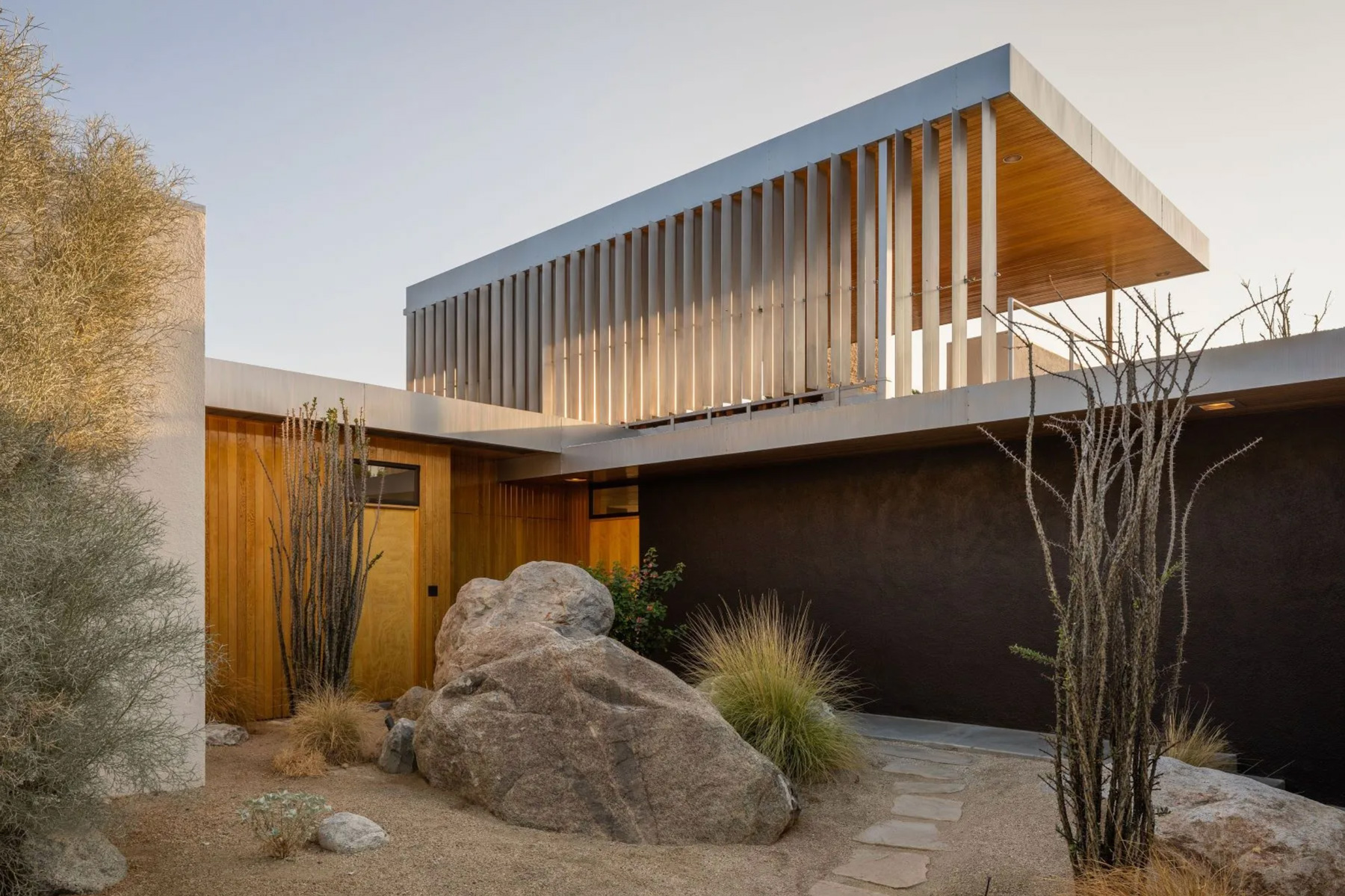
When the windscreens are not required, louvers can be adjusted to open up to the views. Another essential feature of the home is the use of the “wings.” The house is prominently focused on being east- and west- concentrated for sunset and sunrise purposes. The west wing is used for the kitchen and service rooms and the east wing is used for the master bedroom. The family and dining areas located at the center of the home are square to conform to the boxy design of the property. The plan of the house was tailored to the always-warm California climate, which at times can be rather harsh.
When Brent and Beth Harris first saw the Kaufmann House, it was neither a pretty palace nor an obvious candidate for restoration. Strikingly photographed in 1947 by Julius Shulman, it stood vacant for several years after Kaufmann’s death in 1955. Then it went through a series of owners, including the singer Barry Manilow, and a series of renovations. Along the way, a light-disseminating patio was enclosed, one wall was broken through for the addition of a media room, the sleek roof lines were interrupted with air-conditioning units, and some bedrooms were wallpapered in delicate floral prints. Those owners, Brent Harris, an investment manager, and Beth Edwards Harris, an architectural historian, are finalizing their divorce, and plan to auction the Kaufmann House at Christie’s in New York in May. The building, with a presale estimate of $15 million to $25 million, will be part of Christie’s high-profile evening sale of postwar and contemporary art.
During the extensive renovation by Marmol Radziner in the 1990s, the original concrete and silica sand floors were patched. Neutra’s International Style architecture is heightened by the San Jacinto Mountains above. Frank Lloyd Wright’s Home and Studio were the breeding grounds for a new modern American Architecture.
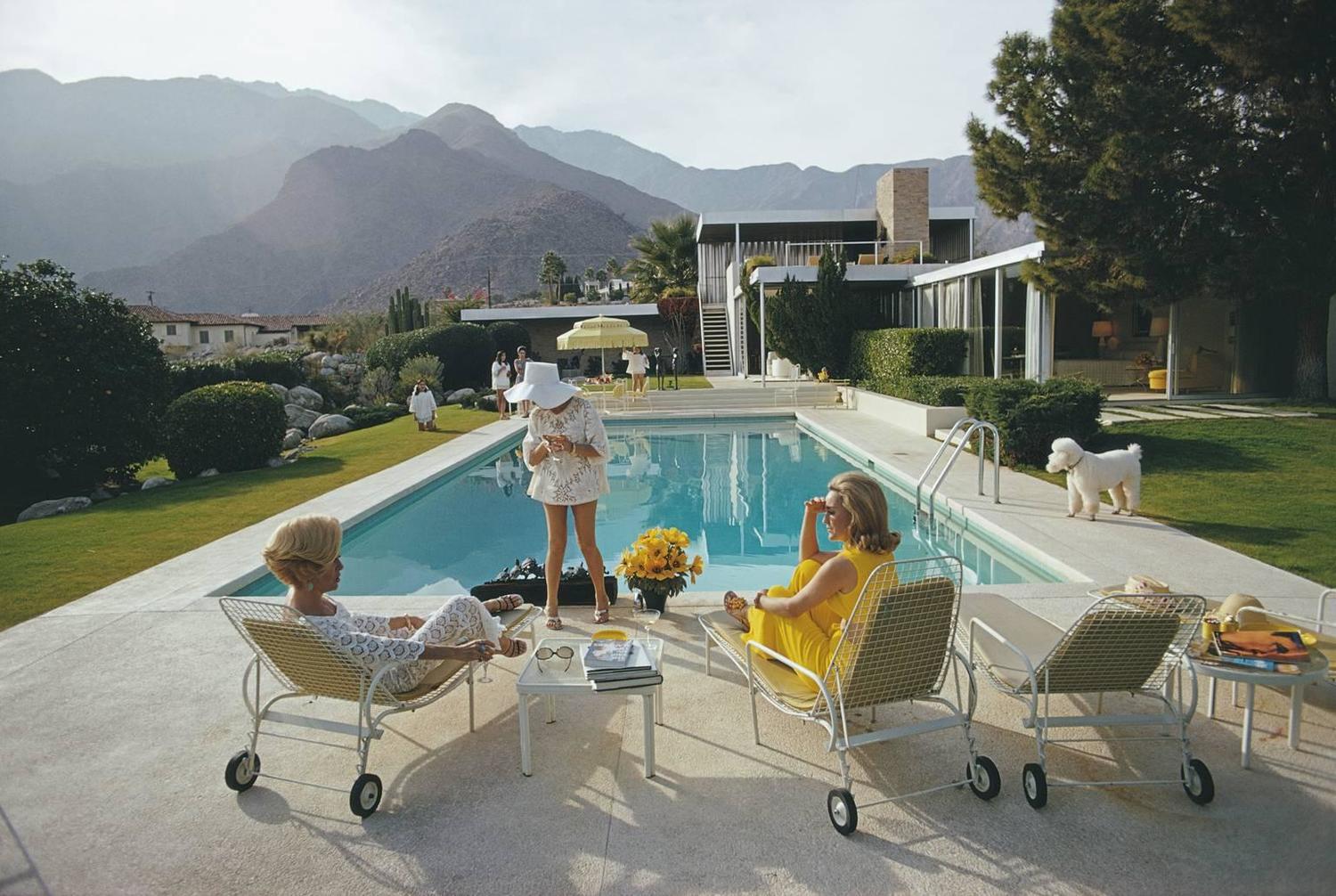
The gloriette, a serene outdoor room above the house, was Richard Neutra’s creative way of bypassing zoning codes that forbade two-story structures. Everything from the special concrete–silica sand mixed floors to the Fresnel lenses on the ceiling lights has been meticulously reproduced to re-create those golden years. But one of the most memorable former owners is socialite and philanthropist Nelda Linsk, who was captured by Aarons chatting poolside with model Helen Dzo Dzo in 1970.


No comments:
Post a Comment